THE PASS / THE WHOLE CHICKEN
Restraint.
On the art of trussing, the discipline of heat, and the peculiar intimacy of tying up a chicken.
An essay by Andre Ford
There she is again. Only now, the legs are no longer crossed.
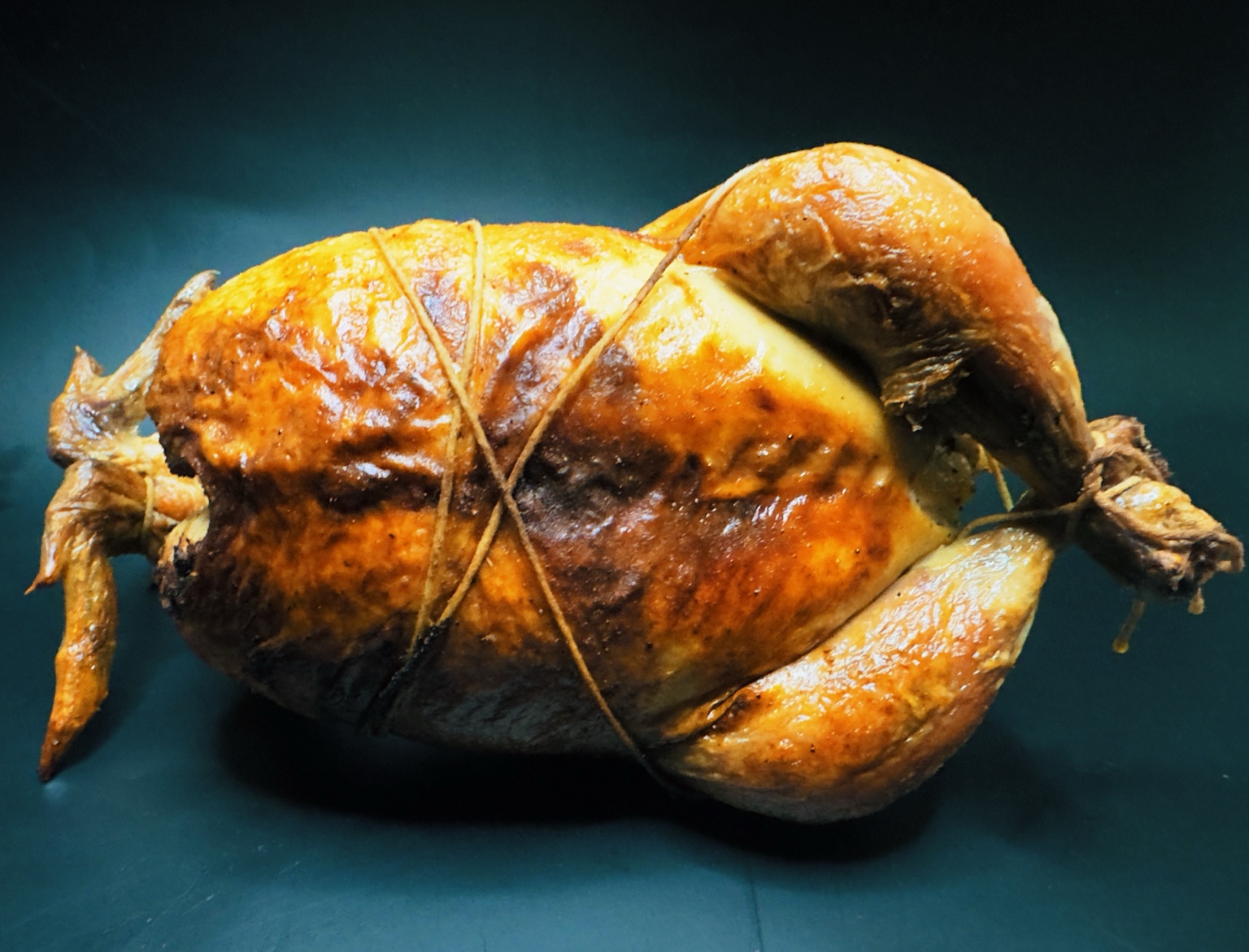
The chicken that previously reclined with the languid confidence of a woman posing for a particularly suggestive portrait has been bound with kitchen twine, her wings secured, her legs drawn together, and her entire body subjected to an arrangement that seems unnecessarily elaborate for something destined to become dinner.
The transformation is striking.
The pale, soft figure of the first photograph has become a deeply golden roast, its skin taut and glistening, its contours held in place by a series of carefully positioned strings.
One could reasonably wonder whether the chicken has wandered into the wrong kind of cookbook.
There is a certain Fifty Shades of Grey quality to the proceedings. The ropes are deliberate. The positioning is exact. The subject has been thoroughly restrained.
But unlike the more theatrical applications of bondage, culinary trussing has an entirely practical purpose.
At least, that is what we tell ourselves.
The truth is that tying up a chicken is one of those kitchen rituals that manages to be useful, aesthetically satisfying, occasionally unnecessary, and faintly ridiculous all at once.
It is also an excellent place to begin a conversation about control. Because roasting a whole chicken is, above all, an exercise in understanding what the cook can control, what the cook cannot, and when restraint is more valuable than intervention.
The Art of Binding
Trussing is the practice of securing poultry with kitchen twine to hold the body in a particular shape during cooking.
In classical kitchens, the technique is taught as part of the foundational vocabulary of poultry preparation. A properly trussed bird presents a compact, orderly silhouette. The legs sit close to the body. The wings are secured rather than projecting outward. The breast remains prominent, and the entire arrangement appears composed.
The visual effect is undeniable. A trussed chicken looks as though someone has taken charge of the situation.
But appearances are not the same as cooking performance.
The traditional justification for trussing is that a compact bird retains its shape, protects exposed extremities, and can be handled and presented more neatly. These are legitimate advantages, particularly when the finished bird will be brought to the table whole.
Yet trussing also changes how heat reaches the meat.
Drawing the legs tightly against the body can reduce airflow around the joints and slow cooking in areas where the thigh meets the breast. That matters because the breast and legs do not have identical cooking requirements.
Breast meat is relatively lean. Leg meat contains more connective tissue and generally benefits from additional cooking beyond the minimum temperature required for safety.
An aggressively trussed chicken can therefore make an existing problem more complicated: the breast may approach its ideal doneness while the thighs are still catching up.
This does not mean trussing is wrong. It means the technique has consequences.
For my roast chicken, the compact form is part of the intended presentation. The legs are secured, the wings are tucked, and the finished bird retains a deliberate, sculptural quality.
The twine contributes to the photograph as surely as the browning does. It is both a cooking decision and an aesthetic one.
The Night Before
The most consequential part of my roast chicken preparation happens long before the oven is switched on. It begins with salt.
After removing the giblets and drying the chicken thoroughly, I season the bird with kosher salt, freshly cracked black pepper, and a small amount of baking powder.
Then I place it on a rack, uncovered, in the refrigerator for 12 to 24 hours.
There is nothing particularly glamorous about this stage. The bird sits in cold air, exposed, while time performs work that no amount of last-minute enthusiasm can reproduce.
This is dry-brining.
Initially, salt draws moisture toward the surface. Over time, the salt dissolves in that moisture and moves inward through diffusion.
Salt also alters the behavior of muscle proteins, improving the meat's ability to retain water during cooking.
The result is not simply a chicken that tastes saltier. Properly managed, dry-brining produces meat that is seasoned beyond its exterior and can retain more moisture as its proteins contract under heat.
Meanwhile, the uncovered refrigerator environment encourages the skin to dry. This is a separate but complementary effect.
The meat benefits from improved moisture retention. The skin benefits from losing surface moisture.
A successful roast chicken requires both. The apparent contradiction is one of the more elegant aspects of the process: we want water where it contributes to tenderness, and we want less of it where it interferes with crispness.
Time makes that possible. The cook's contribution is largely to leave the bird alone.
The Chemistry of a Crisp Skin
Crisp chicken skin is not merely browned chicken skin. Color and texture are related, but they are not interchangeable.
A surface can become dark without becoming especially crisp. It can also become dry without developing the flavor and color associated with successful roasting.
Chicken skin contains water, fat, collagen, and other proteins. As it heats, moisture evaporates, fat renders, and the collagen-rich structure changes. Once the surface becomes sufficiently dry and hot, browning reactions develop the aromas and flavors we associate with roasted poultry.
The Maillard reaction is central to that development. It occurs through a complex series of reactions involving amino compounds and reducing sugars. Under favorable conditions, these reactions produce the browned pigments and numerous flavor molecules responsible for the savory complexity of roasted meat.
Water complicates the process. As long as substantial surface moisture is evaporating, the skin's temperature is constrained by that evaporation. Drying the surface in advance allows it to reach browning temperatures more efficiently.
This is one reason the overnight refrigerator rest is so useful.
The baking powder in my seasoning mixture serves another purpose. Used in a small quantity, it can raise the pH at the skin's surface, encouraging browning reactions. Its effect is not simply that it makes bubbles, as it might in a cake batter.
The quantity matters. Too much can produce an unpleasant alkaline taste.
The goal is not to turn the chicken into a chemistry experiment. The goal is to use a little chemistry to make the chicken better.
The Discipline of Heat
A roast chicken seems simple because its ingredient list is short and its cooking method familiar.
Place the bird in an oven. Wait. Remove it when done.
That description leaves out nearly everything that matters.
An oven heats a chicken through a combination of radiation, convection, and conduction. Hot air circulates around the bird. Radiant energy reaches its exposed surfaces. Heat moves inward through the meat from the hotter exterior.
But a chicken is not a uniform object.
Its breast is broad and exposed. Its legs are positioned at angles that influence how heat reaches them. The cavity introduces another internal surface, although stuffing it with aromatics can restrict airflow. The bones, fat deposits, and differing thicknesses of muscle all affect the cooking process.
There is no single temperature at which every part of the bird simultaneously becomes perfect.
For this preparation, I begin at 425°F. The initial burst of heat encourages rapid surface drying and browning. After approximately 20 minutes, I reduce the oven to 375°F and continue roasting.
The lower temperature allows the cooking process to proceed with less aggressive surface heating as the interior approaches doneness.
This two-stage approach is not the only legitimate method. Some cooks roast at a constant high temperature. Others begin gently and finish with intense heat. Some remove the backbone and flatten the bird, increasing exposed surface area and reducing the differences in cooking time between its parts.
Each method represents a different solution to the same problem.
A clock is useful for planning, but it cannot determine doneness with sufficient precision.
Two chickens of identical weight may cook differently because of their shape, starting temperature, fat distribution, and the performance of the oven.
For food safety, poultry should reach at least 165°F (74°C), measured in the thickest part of the breast and the innermost part of the thigh without touching bone.
The legs may become more tender at higher temperatures, but the minimum safe temperature is not negotiable.
The cook must understand the difference between a temperature that establishes safety and one that produces a preferred texture.
The Problem With Perfection
There is a peculiar mythology surrounding the perfect roast chicken.
It is often described as the ultimate test of a cook's ability: simple enough to expose every mistake, familiar enough that almost anyone can judge the result.
A complicated dish can conceal technical shortcomings beneath layers of sauce, garnish, and presentation. A roast chicken offers fewer places to hide.
Its skin is either properly rendered and browned or it is not. Its breast is moist or dry. Its legs are tender or resistant. Its seasoning is balanced or insufficient.
But the idea of a single perfect roast chicken is less useful than it sounds. Cooking a whole bird involves trade-offs.
A tightly trussed chicken may be beautiful but can cook less evenly than a loosely arranged one. A very high oven temperature may produce exceptional skin while narrowing the margin for error in the breast. A generous coating of butter may encourage attractive color but also introduce milk solids that influence browning.
Even the decision to place aromatics inside the cavity has consequences.
Lemon, garlic, onion, and herbs contribute fragrance, but they do not magically perfume every fiber of the meat. Their influence is strongest in the cavity, nearby juices, and the cooking environment. Packing the cavity too tightly can also interfere with heat circulation.
The cook's responsibility is not to pretend these compromises do not exist. It is to make them deliberately.
My roast chicken is trussed because I want a particular form. It is dry-brined because I want seasoned meat and crisp skin. It begins in a hot oven because I want strong initial browning. It finishes at a lower temperature because I want more control as the interior cooks.
These decisions form a coherent method. That is more meaningful than claiming any one of them is universally correct.
The Beauty of Restraint
The word restraint has two meanings in this kitchen.
The first is literal. Kitchen twine holds the bird in place. The legs are brought together, the wings secured, and the body arranged into a compact shape.
The second is behavioral. The cook must resist the urge to interfere.
Do not continually open the oven to inspect the bird. Do not repeatedly baste the skin if crispness is the objective. Do not increase the heat simply because dinner is running late. Do not carve immediately because the surface looks irresistible.
Each intervention may have a cost.
Opening the oven changes its thermal environment. Frequent basting introduces moisture to a surface we have spent a day drying. Excessive heat can push the breast beyond its preferred doneness before the legs are ready.
And carving too soon releases juices that might otherwise remain distributed within the meat as it rests.
After roasting, I leave the chicken uncovered for approximately 15 minutes.
During resting, the temperature distribution within the meat becomes more even, and some of the moisture displaced during cooking is retained more effectively when the bird is carved.
Covering the chicken tightly with foil traps steam, which can condense against the surface and soften the crispness developed during roasting.
After all that work, it would be a rather unfortunate ending.
So the bird rests without a tent. No additional butter. No last-minute bath of pan juices. No elaborate intervention to prove that the cook is still in charge.
Sometimes the most accomplished thing a cook can do is stop touching the food.
A Portrait of Control
The photograph of the finished chicken is deliberately theatrical.
Its surface is deeply golden, with darker areas where the skin has browned more intensely. The legs and wings have been drawn inward. Kitchen twine travels across the body in visible lines, making the method of restraint part of the composition.
I could have removed the string before photographing it. That would have produced a more conventional image of a finished roast.
But the twine is the point.
It tells the viewer something about what happened before the photograph was taken. It exposes an element of the technique rather than hiding every trace of preparation.
The first image, the reclining raw chicken, was a study in anthropomorphism. By giving the bird a familiar human pose, I made an ordinary ingredient appear unexpectedly expressive.
The second photograph uses the opposite strategy. The bird is no longer pretending to be at leisure. It has been arranged, bound, heated, and transformed into something unmistakably culinary.
And yet the human associations remain. There is still a body. There are still limbs. There is still the suggestion of a pose.
The humor has become darker, though no less deliberate.
The photographs work together because they make visible a process that usually happens without much consideration.
We begin with an animal body. We impose structure. We apply heat. We call the result dinner.
The sequence is ordinary. The photographs make it strange.
What the String Cannot Do
A piece of kitchen twine can hold a chicken in place.
It cannot correct poor seasoning. It cannot compensate for an oven that is too hot or too cold. It cannot prevent overcooking. It cannot make a breast and thigh behave like identical cuts of meat.
It is a tool, not a guarantee.
The same is true of nearly every technique involved in roasting.
Dry-brining improves the conditions for seasoning and moisture management, but it does not excuse careless cooking. Baking powder can assist browning, but it cannot produce crisp skin on a wet surface without sufficient heat. A carefully arranged cavity of herbs and citrus may contribute fragrance, but it cannot substitute for properly seasoned meat.
Technique is most effective when the cook understands both its capabilities and its limits.
A good roast chicken does not require an elaborate collection of tricks. It requires a series of sound decisions, made in the correct order, with enough patience to allow each one to work.
Dry the bird. Season it. Give the salt time. Arrange the body with purpose. Apply heat intelligently. Measure doneness. Allow the meat to rest. Then, finally, remove the string.
The process is not particularly mysterious. But simplicity and ease are not the same thing.
The Release
There is a small satisfaction in cutting the twine from a finished roast chicken.
The strings that once held everything in position are no longer necessary. The skin has browned. The meat has cooked. The bird has rested.
The work of restraint is complete.
The knife slips beneath the string, and the tension disappears. Now the chicken can be carved.
The legs separate at their joints. The wings come away. The breast is removed from the bone and divided into portions. The compact whole becomes a collection of individual servings.
It is the reverse of the process with which we began.
In Anatomy, the whole bird invited us to consider its structure before cooking. Here, that same structure has been manipulated to produce a particular result. At the table, the body is divided once more, this time with the intention of eating it.
There is no need to pretend that roasting a chicken is a profound moral drama. Sometimes dinner is simply dinner.
But there is also no reason to deny that ordinary cooking contains its own peculiar theater.
A pale bird lounges with crossed legs. The cook arrives with a length of twine. A day passes in the refrigerator. Heat transforms the skin. The strings remain visible against a burnished surface.
And eventually, everything is released.
The best part of the joke is that the restraint was never really about the chicken. It was about the cook.
Knowing when to intervene, how much force to apply, and when to leave well enough alone.
After all, a properly roasted chicken should require very little persuasion at the table.
THE WHOLE CHICKEN / COMPANION FEATURE
The Whole Roast Chicken — Recipe →
Original photography and recipe by Andre Ford.