THE PASS / THE WHOLE CHICKEN
Anatomy.
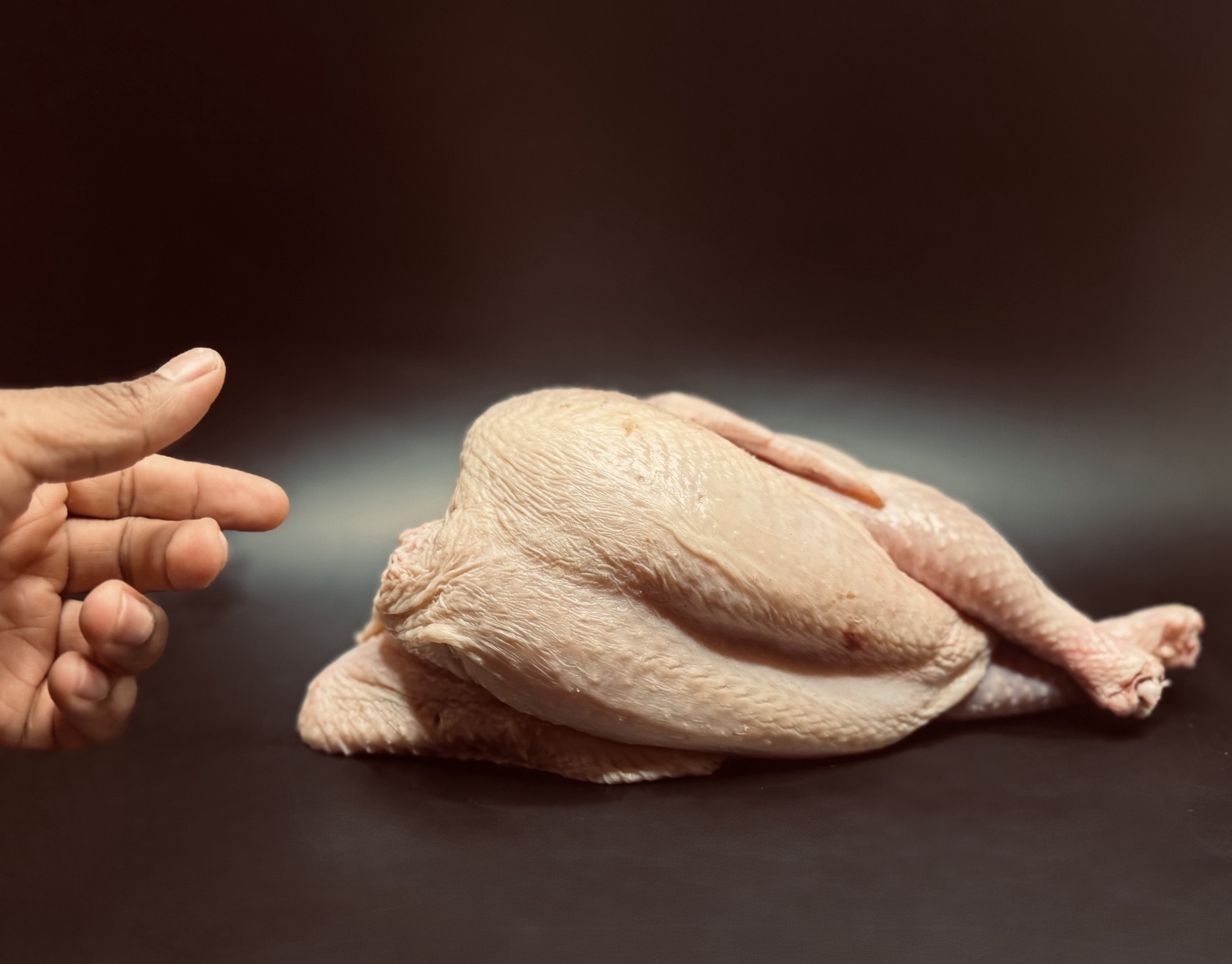
On the whole chicken, the intimacy of preparation, and the strange distance between an animal and an ingredient.
An essay by Andre Ford
She has crossed her legs.
There is no particularly dignified way to describe the photograph. A whole, uncooked chicken reclines against a dark background, one leg resting suggestively over the other, her pale skin illuminated with the sort of attention ordinarily reserved for a fashion editorial. She appears relaxed, perhaps even a little pleased with herself. The pose is absurd, and the absurdity is entirely intentional.
A chicken has no interest in being seductive. This one has been arranged to suggest otherwise.
I wanted to see what would happen if I photographed an ordinary ingredient as though it were a person accustomed to having her portrait taken. Not a beautifully prepared dinner. Not a rustic still life involving garlic, lemons, and a strategically placed sprig of rosemary. Just the bird, unadorned, adopting a pose that seems almost indecently familiar.
The result is funny. It is also faintly uncomfortable. The crossed legs make it difficult to forget that this is an entire body. And that, perhaps, is the most interesting thing about a whole chicken.
The Body on the Board
A chicken is one of the most familiar ingredients in the modern kitchen. It is adaptable to nearly every major culinary tradition, and so common that its presence rarely invites examination.
We roast it, fry it, braise it, grill it, steam it, poach it, and turn it into stock. We serve it whole or divide it into pieces. We buy its breasts without bones, its thighs without skin, its wings by the dozen.
Somewhere in this extraordinary versatility, the animal becomes almost invisible.
The language helps. We speak of breasts, thighs, legs, and wings as though they were independent products rather than parts of a once-living organism. These are anatomically accurate terms, but the commercial presentation encourages us to understand them primarily through their culinary functions.
The breast is lean. The thigh is forgiving. The wing is suitable for frying. The carcass is useful for stock.
A whole chicken interrupts that separation. The legs are attached to the hips. The wings connect to the shoulders. The breast covers the sternum. The backbone runs along the opposite side. Beneath the skin lie muscles, connective tissue, fat, and bone, organized into a body that once performed the ordinary activities of an animal.
That is not an argument against eating it. It is an argument for understanding what we are eating.
A cook who knows the anatomy of a chicken is better equipped to prepare it. The structure explains where to cut, how to separate a joint without splintering bone, why some muscles become tender quickly while others benefit from longer cooking, and how to extract value from portions that might otherwise be discarded.
Anatomical knowledge is practical. It also changes the relationship between the cook and the ingredient.
The Geography of a Chicken
The breast and thigh belong to the same animal, but they do not behave like the same meat. The difference begins with function.
A chicken's breast muscles are used primarily for relatively brief, powerful movements associated with the wings. They contain a high proportion of fast-twitch muscle fibers and comparatively little myoglobin, the oxygen-binding protein that contributes to the darker color of more actively used muscles.
The legs perform a different kind of work. Walking, standing, and supporting the animal's weight require sustained activity. The muscles of the thighs and drumsticks contain more myoglobin and generally more connective tissue. They also contain more fat than the breast.
These distinctions have consequences in the kitchen. Breast meat is comparatively lean and can become dry when cooked beyond the point necessary for doneness. Leg meat is more tolerant of extended cooking and often benefits from reaching a higher temperature, which softens connective tissue.
This is the central complication of roasting a chicken whole. The cook is attempting to prepare several different kinds of meat, attached to one skeleton, using a single heat source.
The breast and legs do not necessarily reach their ideal eating qualities at the same moment. The familiar golden roast chicken, then, is not quite as simple as its reputation suggests. It is a negotiation between competing anatomical requirements.
A whole chicken asks the cook to understand the body before attempting to control it.
The Skin We're In
Then there is the skin.
In my photograph, the skin is the most visually prominent feature. It stretches across the breast in delicate folds, gathering around the joints and forming fine wrinkles where the body bends. It is an unexpectedly expressive surface.
Raw chicken skin is pale, soft, and slightly translucent. It carries subcutaneous fat and contains collagen, a structural protein that changes as it heats. Under the right conditions, the skin becomes one of the most desirable parts of the roasted bird.
That transformation is a matter of moisture, fat, and temperature. A wet surface resists browning because energy is initially spent evaporating water. Once sufficient moisture has been removed, the surface temperature can rise and browning reactions can proceed more readily.
This is why drying the bird before roasting matters. It is also why an uncovered overnight rest in the refrigerator can improve the finished skin. The cold, circulating air encourages surface moisture to evaporate while salt alters the behavior of the meat beneath.
In my roast chicken preparation, the bird spends 12 to 24 hours uncovered on a rack after being seasoned with salt, pepper, and a small amount of baking powder.
The salt contributes seasoning and changes the way muscle proteins retain water. The baking powder raises the skin's surface pH, helping promote browning and crispness when heat is applied.
The skin that appears almost fragile in the raw photograph will eventually become taut, deeply colored, and crisp. The same surface, entirely transformed.
The Question of Wholeness
Modern food retail has made convenience a defining characteristic of meat. A boneless, skinless chicken breast requires little anatomical understanding. It arrives already separated from the skeleton, trimmed, portioned, and ready for a pan.
There is nothing inherently wrong with that convenience. But it changes what the cook encounters.
A whole bird retains the evidence of its construction. Its shape determines how it fits into a pan. Its joints dictate the direction of the knife. Its bones influence heat transfer. Its fat and connective tissue contribute to the flavor and texture of the finished dish.
The ingredient resists complete abstraction.
There is also an economic argument for learning to work with a whole chicken, although buying whole is not automatically cheaper in every market.
When prices make it worthwhile, one bird can provide several meals and multiple preparations. Breasts can be removed for quick cooking, legs reserved for braising, wings saved for another dish, and the remaining carcass used for stock.
A chicken's value is not limited to its most expensive cuts. The skeleton, often treated as waste, contains connective tissue, residual meat, and flavor that can be extracted through simmering.
Understanding the whole bird expands the possibilities available to the cook. It also makes waste more visible.
An Uncomfortable Familiarity
There is something peculiar about giving an animal a human pose after it has already become food.
The photograph works because the resemblance is immediate. A crossed leg is a small, recognizable gesture. It suggests ease, self-possession, perhaps flirtation. We have seen people sit this way in advertisements, portraits, films, and ordinary conversation.
The chicken cannot perform the gesture. I have performed it on her behalf.
That distinction is the joke, but it is also the source of the discomfort.
We are accustomed to seeing raw meat photographed in ways that emphasize freshness, abundance, and desirability. A steak glistens beneath studio lighting. A rack of lamb is arranged to emphasize its symmetry. A whole fish rests on ice with its scales carefully illuminated.
These images make food attractive by directing attention toward qualities we have learned to associate with appetite.
My chicken is doing something different. She is not surrounded by the visual vocabulary of a recipe. There are no vegetables to suggest a forthcoming meal, no herbs to imply fragrance, no roasting pan to establish culinary purpose.
The photograph offers almost no reassurance that this is food. Instead, it asks the viewer to look at the body itself.
And because the body has been given a familiar human gesture, the viewer is encouraged to recognize something beyond its culinary utility.
The photograph does not need to deliver a moral verdict. Humor is often more effective when it leaves a little uncertainty intact.
I can find the image ridiculous and still recognize that its ridiculousness reveals something about how we look at animals once they have entered the kitchen.
The Cook and the Animal
There is a longstanding tension in culinary culture between reverence for ingredients and the language of mastery.
Cooks speak of respecting the product, honoring the animal, and using every part. We also speak of breaking down carcasses, controlling temperatures, rendering fat, and extracting flavor.
The first vocabulary suggests gratitude. The second describes technique. Both belong in the kitchen.
Respect without knowledge can become sentimental. Technique without consideration can become merely mechanical.
A serious cook needs neither romantic mythology nor deliberate indifference. What matters is understanding the material, recognizing its origins, and using skill to prepare it well.
For a whole chicken, that begins before the seasoning. It begins with knowing what the bird is.
Where the joints are located. How the breastbone divides the chest. How the skin protects the meat. Which muscles are lean, which contain more connective tissue, and how those differences influence the cooking process.
These details are not separate from the pleasure of eating. They make that pleasure possible.
Before the Heat
The raw chicken and the roasted chicken are the same subject, photographed at opposite ends of a transformation.
In the first image, the bird is pale, soft, and arranged with a kind of mischievous intimacy. In the second, its surface is burnished, its shape controlled by twine, and its skin marked by heat.
Between the two images lie decisions about seasoning, time, moisture, temperature, and technique.
The raw bird retains the softness and irregularity of an animal body. The roasted bird has been organized into the familiar image of a finished dish.
We have learned to recognize one as an ingredient and the other as dinner. Yet the distinction is less absolute than it appears.
The cook has not created an entirely new object. The cook has transformed what was already there.
My reclining chicken began as a joke. A little crossed-leg attitude. A suggestion of impropriety. A raw bird behaving as though she had somewhere better to be.
But the photograph accomplishes something beyond the joke. It makes an ingredient difficult to overlook.
Before we season it, bind it, roast it, carve it, and place it on the table, we have to acknowledge the whole thing.
The body comes first.
THE WHOLE CHICKEN / COMPANION FEATURE
The Whole Roast Chicken — Recipe →
Original photography and recipe by Andre Ford.