The Color of Ube.
On the purple yam, Filipino baking, and the difference between a beautiful ingredient and a beautiful idea.
By Andre Ford
There is something almost unreasonable about the color of ube.
Slice into the right purple yam and the flesh reveals a violet so saturated it seems artificial. Cook it down with milk, butter, and sugar, and the color deepens into something between lavender and ink. It looks like an ingredient invented for photography. A pastry chef’s fantasy. The sort of thing you would expect to find in a laboratory rather than pulled from the ground.
But ube is a yam. An actual tuber. It grows in soil, requires cultivation, and has been part of Filipino cooking for generations.
The color is simply one of its more conspicuous qualities.
Its flavor is harder to describe. People reach for vanilla, pistachio, white chocolate, and coconut, none of which quite captures it. Ube has an earthy sweetness, a gentle nuttiness, and a rounded quality that becomes more pronounced when cooked with fat and dairy. It can be subtle enough to disappear beneath stronger ingredients, which is one reason the balance of an ube dessert matters considerably more than its appearance.
The first mistake is assuming the purple is the point.
Long Before the Photograph
Ube, botanically Dioscorea alata, belongs to a family of yams cultivated across tropical regions of the world. In the Philippines, it has a particularly rich culinary identity.
Its most recognizable preparation is ube halaya, a thick, sweet preserve traditionally made by cooking mashed purple yam with milk, sugar, and fat. Depending on the household and recipe, coconut milk, condensed milk, evaporated milk, and butter may all play a part.
The process is deceptively simple. The mixture cooks slowly, requiring regular stirring as moisture evaporates and the starch thickens. Eventually it becomes glossy, dense, and rich enough to hold its shape.
That transformation is worth understanding.
Raw ube does not taste like the intensely sweet purple desserts that have become familiar on social media. Much of that character comes from preparation. Milk softens its earthiness. Sugar brings forward its sweetness. Butter supplies richness. Heat brings everything together.
Halaya is eaten on its own and incorporated into cakes, pastries, ice creams, and other sweets. It also has a place in Filipino celebrations and family cooking that long predates the international appetite for photogenic purple food.
This matters because ingredients do not suddenly become interesting when the rest of the world discovers them.
Ube was already interesting.
When an Ingredient Becomes an Aesthetic
The modern popularity of ube was probably inevitable.
It has everything contemporary food culture rewards. An immediately recognizable color. A name short enough to remember. An appearance that translates beautifully through a camera lens.
Purple doughnuts. Purple croissants. Purple lattes. Purple soft serve. Entire bakery displays that look as though someone adjusted the saturation.
Some of these are excellent. Others seem to have been developed with considerably more attention to color than flavor.
There is also a practical distinction worth making. Not every purple dessert contains meaningful amounts of ube. Some rely heavily on flavoring extracts, added color, or combinations of ingredients designed to approximate its appearance. Purple sweet potatoes, particularly Okinawan varieties, are also sometimes confused with ube, although they are botanically different.
None of this automatically makes a dessert inferior. Extracts can be useful. Color can be part of a dessert’s appeal. A good pastry chef understands that appearance is an ingredient in the experience, even if it never appears on the recipe card.
But the finished product should deliver something beyond its photograph.
The question I find more interesting is what happens when you stop treating ube as a novelty and start treating it as an ingredient with its own culinary properties.
What does it contribute to texture? How does its starch behave? What happens when its flavor meets fermentation, cultured dairy, or caramelized sugar?
That is where the possibilities become much more compelling.
Two Ways Into the Kitchen
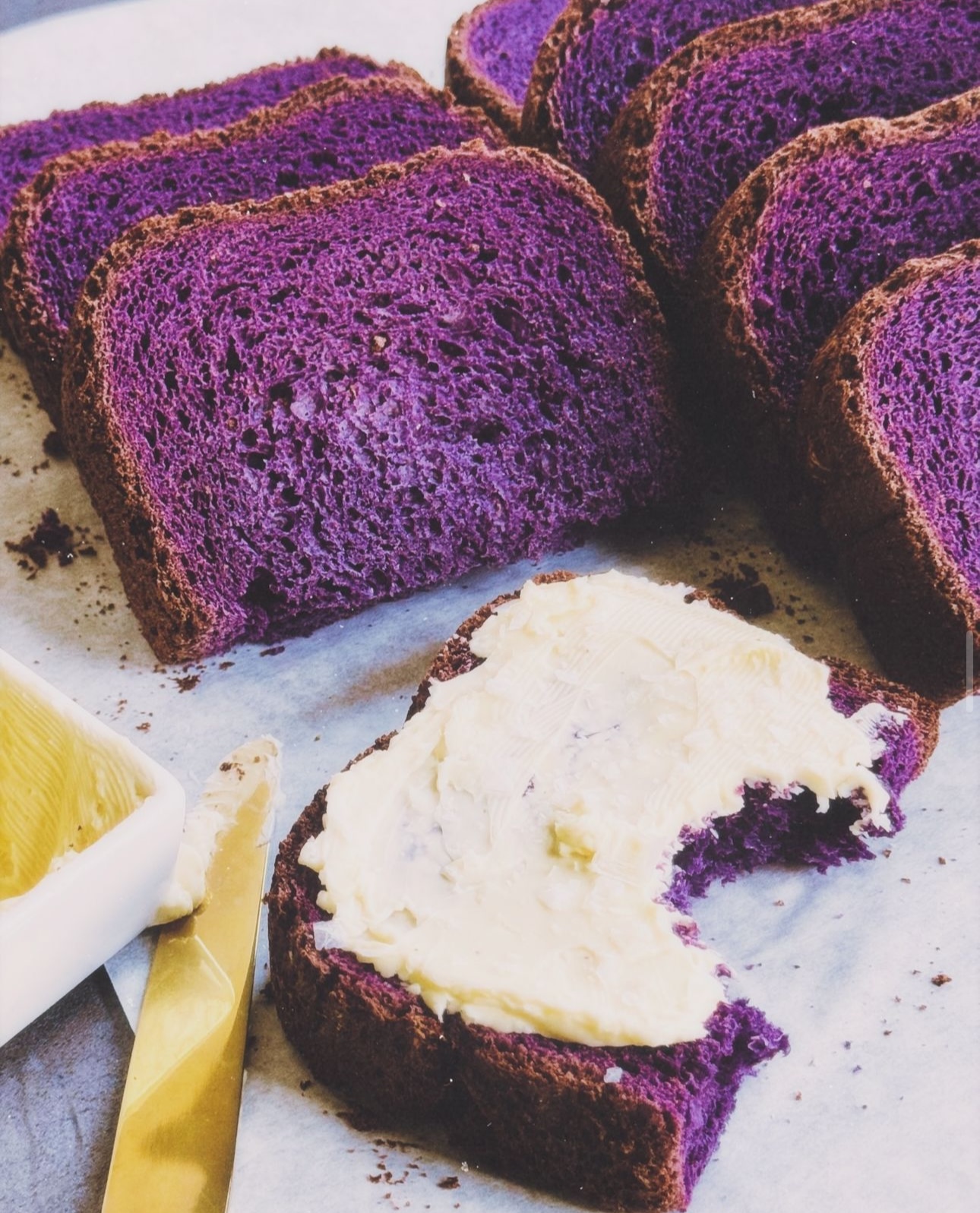
Ube Milk Loaf
A soft enriched bread with tangzhong and ube halaya.
VIEW RECIPE →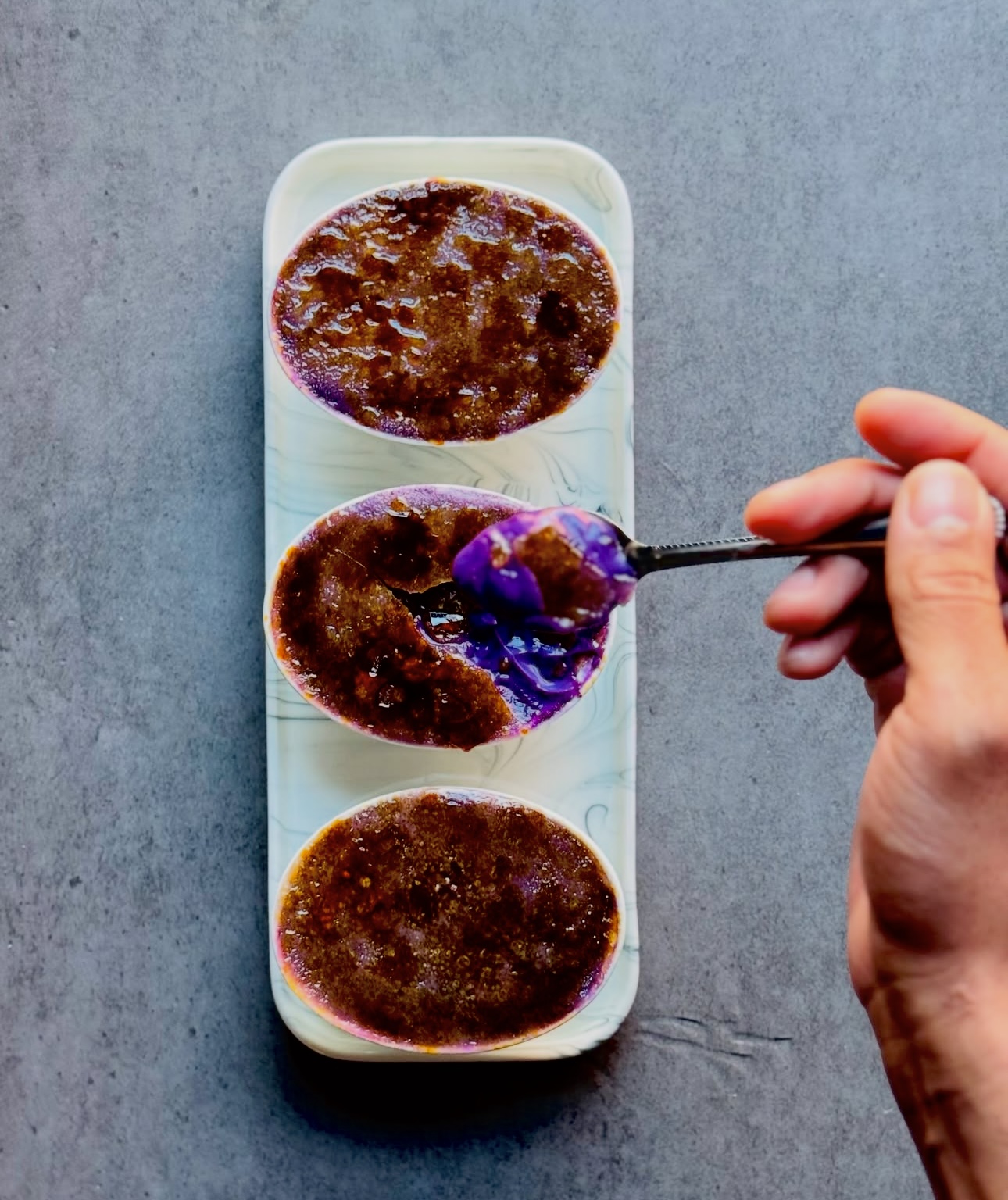
Ube Crème Brûlée
A silky purple yam custard beneath caramelized sugar.
VIEW RECIPE →These two preparations interest me because they ask different things of the same ingredient.
Bread depends on gluten development, fermentation, and moisture management. Custard depends on the controlled coagulation of egg proteins. Ube must work within those structures rather than dominate them.
The milk loaf benefits from tangzhong, a technique in which a portion of the flour is cooked with liquid before mixing. Gelatinizing some of the starch allows the dough to retain more moisture, producing a soft crumb that stays tender longer. The ube contributes another layer of starch and flavor, but it also introduces variability. A particularly wet halaya can change the dough’s hydration.
The crème brûlée presents a different problem. The custard must be rich enough to carry the ube without becoming heavy or grainy. The mixture needs careful blending and straining. Gentle baking preserves its texture. The caramelized sugar on top supplies a welcome bitterness, keeping the dessert from becoming monotonously sweet.
Neither preparation requires a radical reinvention of technique.
Both require understanding what the ingredient is doing.
The Question of Authenticity
There is a temptation, particularly when working with ingredients from cultures other than one’s own, to become preoccupied with whether a preparation is authentic.
It is a reasonable concern, but authenticity is not always a useful binary.
Ube halaya belongs to a Filipino culinary tradition. That origin should be acknowledged clearly. An ube crème brûlée is not a traditional Filipino dessert merely because it contains a Filipino ingredient. Nor does it need to pretend to be one.
It is a French custard preparation incorporating ube.
That description is accurate, and accuracy is a good place to begin.
Food has always traveled. Ingredients cross borders, techniques migrate, and cooks adapt what they know to what is available. The history of pastry is full of borrowing, refinement, and reinvention.
What matters is whether that exchange is informed.
Knowing where an ingredient comes from should deepen the work rather than restrict it. Understanding the original preparation gives you a better foundation for making something different.
There is a considerable difference between using ube because purple happens to be fashionable and using it because you understand what it can contribute.
The latter tends to produce better food.
A Place Beyond the Trend
I suspect ube will eventually lose some of its novelty in Western food culture. Most ingredients that experience sudden popularity do.
The purple lattes will become less surprising. The novelty pastries will make room for whatever catches the internet’s attention next.
That would not be a loss.
An ingredient’s long-term value has very little to do with its ability to attract attention. Vanilla is no longer novel. Neither is chocolate, cinnamon, or pistachio. We continue using them because they are useful, delicious, and capable of extraordinary variation.
Ube deserves the same consideration.
I like the idea of a purple milk loaf sitting on a kitchen counter, sliced thick and toasted with salted butter. No elaborate presentation. No explanation required beyond what it is.
I like the contrast of a brittle caramel crust breaking into a cool violet custard. The slight bitterness of the sugar, followed by the gentle sweetness of the yam.
Both are beautiful, certainly.
But the pleasure should survive the moment the camera is put away.
That is the test I care about.