THE PASS / ESSAY
Southern.
Original recipes and writing by Andre Ford
On abundance, appetite, the ceremonial ham, and the complicated business of having enough.
There is nothing modest about this ham.
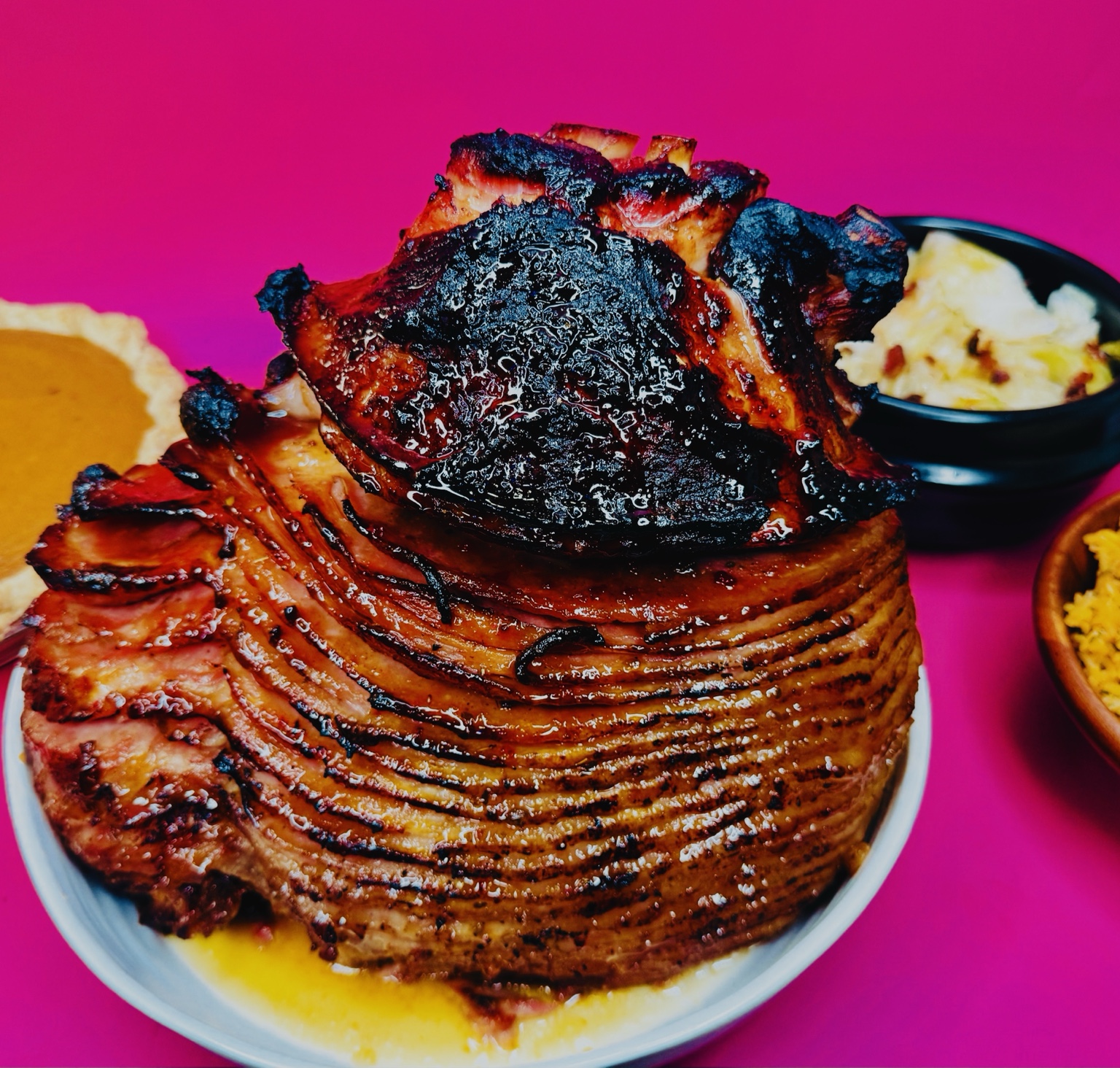
It arrives at the table bronzed and lacquered, its spiral-cut edges darkened almost to the point of impropriety. The glaze has collected in the folds, where mustard, brown sugar, and heat have produced something glossy, sticky, and considerably more interesting than the pale pink meat beneath.
Against a bright pink background, the whole affair borders on theatrical.
Good.
I have very little interest in a ham that looks apologetic.
The photograph is deliberately excessive. There is no tasteful scattering of herbs, no rustic linen, no suggestion that this enormous piece of pork might reasonably constitute a light supper. The ham is the entire production. Its exterior is dark and dramatic, the exposed edges almost black in places, the sweetness concentrated into a crust that promises to cling to both the knife and the fingers.
It is not subtle food.
But Southern food has never been adequately explained by subtlety alone.
There is a particular kind of abundance associated with the Southern table, one that has become so familiar in American cultural imagery that we rarely stop to examine what it means. Biscuits piled in baskets. Greens simmered in enormous pots. Cornbread passed from hand to hand. Fried chicken, macaroni and cheese, sweet potatoes, deviled eggs, cakes, pies, and a ham substantial enough to suggest that someone may have invited the entire congregation.
The imagery is seductive.
It is also incomplete.
Because abundance is not merely a quantity of food.
It is a language of hospitality, an expression of economic circumstance, a performance of generosity, and sometimes a rather elaborate way of concealing how much work went into making everything appear effortless.
To understand the Southern table, one has to look beyond what is being served.
One has to consider who prepared it, who is invited to eat, who gets the best portion, and what happens after everyone has gone home.
The Geography of an Appetite
The American South is frequently discussed as though it possesses a single culinary identity.
It does not.
The region contains coastal communities, mountain settlements, agricultural plains, major cities, and distinct histories of migration and settlement. The foodways of the Lowcountry differ from those of Appalachia. Louisiana's culinary traditions cannot be collapsed into those of Tennessee. The cooking of eastern North Carolina is not interchangeable with that of west Texas.
Even the word Southern is more complicated than it appears.
There are multiple Souths, overlapping in geography but not always in experience.
What unites many of their culinary traditions is less a fixed collection of dishes than a long history of adaptation: people working with what could be grown, raised, preserved, traded, purchased, or otherwise obtained.
Pork occupies an important place in that history.
Before industrial refrigeration, pigs offered practical advantages to rural households. They could be raised in a variety of environments, and their meat could be salted, smoked, rendered, and preserved in different forms.
A slaughtered hog was not simply a collection of chops.
It represented fat for cooking, bones for broth, meat for immediate consumption, and cuts that could be cured for later use.
The ham, particularly when salted and smoked, became an important preserved product.
Traditional country ham and the modern spiral-cut holiday ham are not the same thing. Country ham is typically dry-cured and may be aged, developing a concentrated saltiness and firm texture. The familiar supermarket spiral ham is generally wet-cured, often smoked, fully cooked, and sold ready for reheating.
The distinction matters.
One is rooted in preservation practices developed long before modern cold storage. The other is a convenient descendant of a much broader American tradition of serving cured pork at gatherings.
The spiral cut itself is a relatively modern commercial innovation, associated with Harry J. Hoenselaar's mid-twentieth-century slicing technology and the growth of HoneyBaked Ham.
It transformed a potentially awkward carving task into a ready-made presentation.
The slices remained attached to the bone, giving the ham the appearance of an intact centerpiece while making individual portions remarkably easy to remove.
Convenience had acquired a certain grandeur.
And grandeur, when properly glazed, can be extremely persuasive.
The Centerpiece
A large ham does something that individual portions of meat cannot.
It announces an occasion.
The difference is partly architectural. A platter of sliced pork chops is a meal. An eight-pound ham, presented whole, is an event.
Its scale changes the behavior of the table.
People gather around it. Someone is assigned to carve, even when the spiral slicing has already done most of the work. The first portions are distributed, the platter begins circulating, and the centerpiece gradually becomes a collection of individual servings.
There is ceremony in that transformation.
The American holiday ham is strongly associated with Easter and Christmas, but its cultural significance extends beyond either celebration. It belongs to a larger tradition in which a substantial piece of meat signals that ordinary restrictions have been temporarily suspended.
Today, a ham may be relatively accessible compared with other celebratory meats. Historically, however, the ability to offer an impressive centerpiece could communicate prosperity, generosity, or both.
And there is a difference between having enough food and being able to demonstrate that you have enough food.
The Southern table has often been represented through the latter.
The platter must appear full. The biscuits must keep coming. Guests should be encouraged to take another helping, preferably before they have finished the first.
Refusing seconds may require a level of diplomacy ordinarily reserved for international negotiations.
Hospitality becomes a performance of plenty.
At its best, that performance is generous and deeply pleasurable.
At its worst, it can become an expectation that someone must fulfill, regardless of the labor or expense involved.
The table looks abundant because someone has made it so.
Who Made the Feast?
Any serious consideration of Southern food must acknowledge the people whose labor created its traditions.
Enslaved Africans and their descendants played foundational roles in the development of Southern American cooking. They brought agricultural knowledge, culinary techniques, ingredients, and food traditions that profoundly shaped the region.
The influence is visible in the cultivation and preparation of foods such as okra, rice, field peas, and greens, and in the development of countless dishes and cooking practices.
Indigenous peoples contributed essential agricultural systems, ingredients, and techniques, particularly those involving corn and other crops native to the Americas.
European settlers introduced additional livestock, crops, and culinary customs, while subsequent generations of cooks adapted these elements to local conditions.
Southern cuisine emerged through contact, exchange, coercion, ingenuity, and unequal access to resources.
It was never the achievement of a single population.
Nor was its development always a cheerful story of cultural collaboration.
Enslaved cooks prepared elaborate meals in households where they possessed little control over their own lives. Black culinary expertise helped establish standards of hospitality and refinement for people who frequently received the public credit.
After emancipation, Black cooks continued to shape Southern restaurants, hotels, private households, churches, and community institutions, often under conditions of profound economic inequality.
The image of the gracious Southern table can therefore conceal a difficult history.
Its elegance was frequently made possible by labor that remained invisible.
This does not diminish the beauty of the food.
It makes understanding that beauty more demanding.
To celebrate Southern cooking without acknowledging Black culinary labor would be to admire the table while refusing to look into the kitchen.
The Sweetness of Excess
The glaze on my ham is built around an argument between mustard and sugar.
Dijon contributes sharpness. Whole-grain mustard provides texture and a slightly different aromatic profile. Dark brown sugar brings sweetness and molasses notes. Maple syrup adds another layer of sweetness, while apple cider vinegar supplies acidity.
Cloves introduce warmth, garlic adds a savory note, and a little cayenne can keep the entire arrangement from becoming too polite.
The ingredients are not particularly mysterious.
Their proportions are what make the glaze work.
Pork is already rich, and cured ham brings salt into the equation. A successful glaze must provide contrast without overwhelming the meat.
Too much sugar, and the ham becomes confectionery.
Too much mustard, and the sauce announces itself more loudly than the pork.
Too little acidity, and the sweetness feels heavy.
The objective is balance, although balance does not necessarily mean moderation.
A richly glazed ham should taste rich.
It should be sweet enough to contrast with the salt, sharp enough to prevent fatigue, and deeply browned enough to introduce flavors that cannot be obtained simply by mixing the ingredients in a saucepan.
Heat supplies the final transformation.
As the glaze concentrates, moisture evaporates and its sugars begin to caramelize. Browning reactions also contribute to the development of roasted flavors.
At the exposed edges of the spiral slices, where the glaze is thin and the heat more direct, the color can deepen dramatically.
These edges are the most interesting part of the finished ham.
They are also the most precarious.
There is a narrow distinction between a dark, complex crust and an unpleasantly burned one.
I want the former.
The photograph makes clear how far I am willing to approach the latter.
A Little Too Far
The term charred has become fashionable in contemporary food writing.
Charred cabbage. Charred scallions. Charred citrus. Charred carrots. Charred almost anything that can survive prolonged contact with a hot surface.
The word suggests intensity, sophistication, and a certain disregard for the timid.
Sometimes it is deserved.
Sometimes it is merely a flattering description of something that has been burned.
A successful char introduces bitterness, smoke-like notes, and textural contrast that can sharpen the flavor of a dish. But excessive burning can produce harsh flavors that overwhelm the ingredient.
In the case of a glazed ham, the challenge is particularly acute because sugar darkens quickly under intense heat.
The final stage of roasting therefore demands attention.
A fully cooked ham does not need to be subjected to hours of aggressive heat. It needs to be reheated appropriately, protected against unnecessary moisture loss, and finished at a temperature sufficient to develop the glaze.
The spiral cuts complicate matters.
They increase the exposed surface area, creating more opportunities for the glaze to settle between the slices. They also provide more edges that can dry out if the ham is heated carelessly.
The very feature that makes the ham attractive makes it vulnerable.
I find that tension appealing.
The exterior should look almost reckless.
The method should be anything but.
The Politics of Plenty
Southern hospitality is often described as an instinctive generosity.
Food appears. Plates are filled. Nobody leaves hungry.
It is a compelling ideal, and one that has genuine roots in family, religious, and community traditions.
But ideals deserve examination, particularly when they become regional identities.
The insistence on abundance can carry complicated expectations.
A host may feel obligated to provide more food than anyone could reasonably consume. A guest may be expected to demonstrate appreciation by eating beyond appetite. Certain dishes may be treated as compulsory expressions of family loyalty.
A refusal of someone's potato salad can become a matter of lasting consequence.
There is comedy in these rituals.
There is also pressure.
The elaborate holiday meal often depends on hours of planning, shopping, preparation, cleaning, and emotional management. That labor has historically fallen disproportionately on women, including Black women whose culinary work was frequently undervalued or taken for granted.
The finished table may communicate effortless generosity.
The effort, however, is very real.
To call a feast an expression of love is reasonable.
To assume that love requires someone to produce a feast is another matter entirely.
The distinction becomes especially important when food is tied to identity.
Southern cooking is sometimes treated as a test of authenticity. A proper biscuit must behave a certain way. Cornbread must contain or exclude particular ingredients. Macaroni and cheese must satisfy an inherited standard. A holiday table without certain dishes may be judged incomplete.
These arguments can be entertaining.
They can also obscure the improvisation that has always been central to regional cooking.
Traditions survive because people repeat them.
They evolve because people change them.
A Southern table should be large enough to accommodate both.
The Second Serving
The most revealing moment in the life of a celebratory ham may come after the celebration.
The guests have gone home. The platter has been cleared. The remaining meat is wrapped and refrigerated.
The centerpiece is no longer impressive.
It is simply a considerable quantity of leftover pork.
And this is where another Southern culinary tradition becomes relevant: the ability to turn yesterday's abundance into tomorrow's meal.
A ham that begins as the centerpiece of a holiday table can reappear in biscuits, sandwiches, beans, soups, casseroles, and countless other preparations.
The transformation is not merely economical.
It can be delicious.
In my kitchen, the leftovers connect directly to another preparation: the pickle-brined panko chicken biscuit.
That sandwich brings together four elements—fried chicken, a tender White Lily biscuit, pimento cheese, and bacon jam.
Each has a distinct purpose.
The biscuit provides a soft, buttery structure. The chicken contributes crunch and savory substance. The pimento cheese supplies sharpness and creaminess. The bacon jam brings sweetness, smoke, and acidity.
Those same components can be repurposed around the ham.
Finely diced leftover pork can be folded into chilled pimento cheese, shaped into croquettes, coated in breadcrumbs, and fried until the exterior is crisp and the interior molten.
The caramelized edges of the ham can become the centerpiece of a grilled cheese sandwich, balanced with sharp cheese and bacon jam.
Remaining biscuits can be split, toasted, and offered with warmed ham, pimento cheese, and condiments, allowing guests to assemble their own small sandwiches.
The ingredients move between dishes.
Nothing is required to remain in its original form.
This is the sort of continuity I find particularly satisfying in cooking.
A recipe does not have to exist as an isolated performance. It can contribute to an ongoing vocabulary of ingredients, techniques, and flavors.
One preparation creates possibilities for another.
The table becomes less a collection of finished dishes than a system of relationships.
And abundance begins to mean something more useful than excess.
What Remains
There is a difference between generosity and waste.
A generous table offers enough.
An excessive table offers more than anyone can use.
The boundary is not always obvious, and there are occasions when a little extravagance is entirely appropriate.
I am certainly not proposing that the holiday ham be reduced to a sensible portion of lean protein accompanied by a restrained selection of steamed vegetables.
That would be a very different photograph.
I want the glaze. I want the dark edges. I want the enormous platter and the slightly unreasonable quantity of food.
I want the pleasure of a centerpiece that makes people stop talking for a moment when it arrives.
But I also want to know what happens next.
How the remaining meat will be used. Whether the bones can contribute to a pot of beans or stock. Whether the condiments prepared for one meal can become the foundation of another.
These questions do not diminish the celebration.
They extend it.
A good feast should leave memories.
It need not leave an unreasonable amount of waste.
There is something almost elegant about that distinction: the spectacle is temporary, but the usefulness continues.
Southern, Without Apology
The photograph of my charred spiral ham does not attempt to make the dish appear restrained.
The pink background is emphatic. The glaze is dark. The spiral slices reveal their edges with almost architectural precision.
It is a portrait of abundance.
There is pleasure in that image, and a certain amount of deliberate provocation.
The ham looks expensive in effort, excessive in presentation, and entirely uninterested in being described as healthy.
I like it that way.
But I am also interested in the history beneath the gloss.
The preservation practices that made pork important to Southern households. The Black culinary expertise that shaped the region's food. The complicated traditions of hospitality. The labor concealed behind a seemingly effortless feast.
And the small, practical intelligence required to make use of what remains.
These histories do not fit neatly into a single photograph.
They should not have to.
A dish can be beautiful and complicated. A tradition can be cherished and questioned. A feast can be both an act of generosity and a performance shaped by expectations.
Southern food is capacious enough to contain those contradictions.
Perhaps that is why its most recognizable dishes remain so compelling.
They are rarely only about flavor.
They are about family, class, labor, geography, memory, aspiration, and the persistent human desire to demonstrate that there is enough to go around.
My ham participates in that tradition with considerable enthusiasm.
It is sweet, sharp, salty, deeply browned, and perhaps just a little too dramatic.
The edges have been pushed toward darkness. The glaze has settled into every fold. The whole thing looks as though moderation was discussed and politely dismissed.
There will be enough for everyone.
And tomorrow, there will be sandwiches.
The Chicken Biscuit
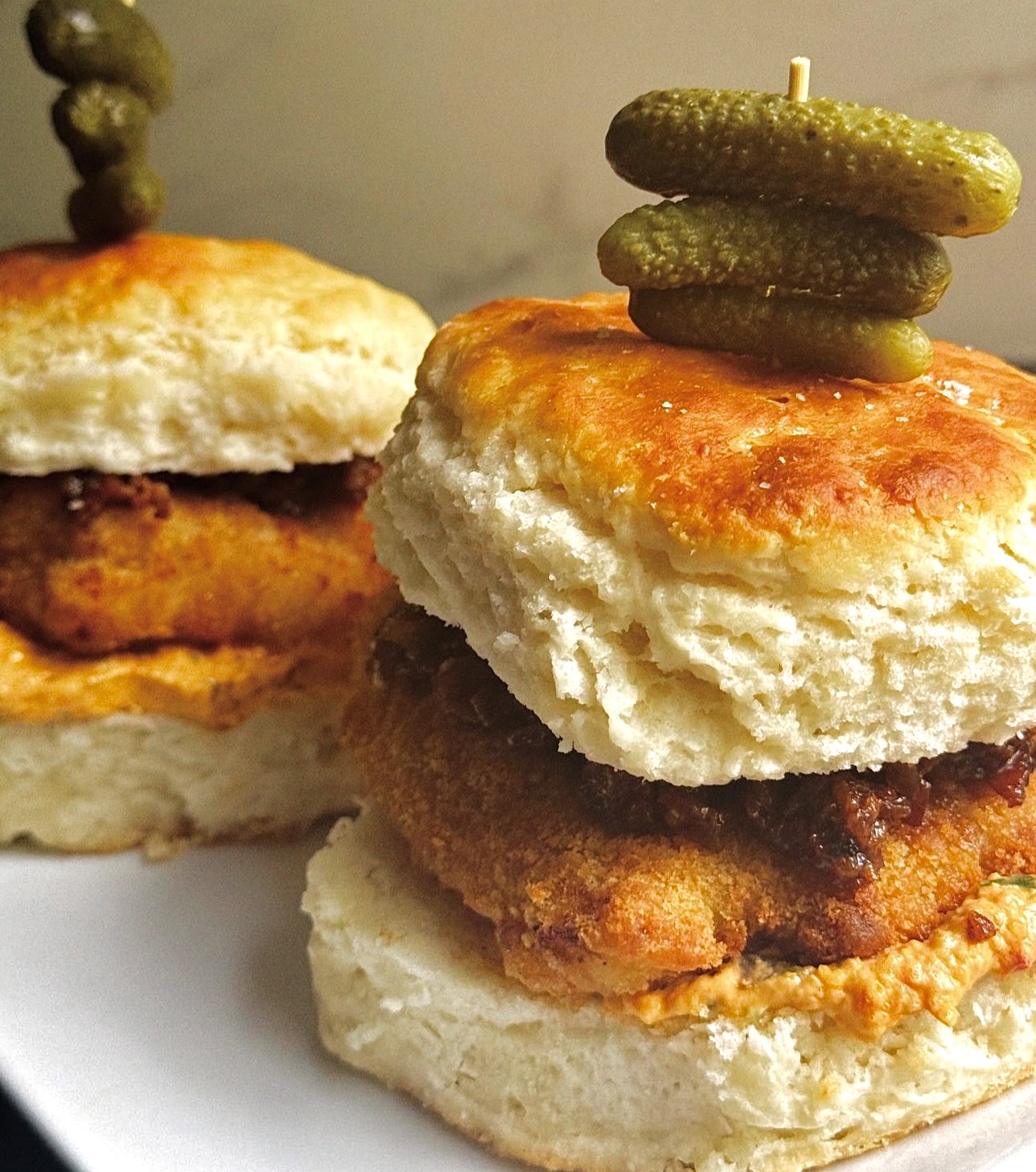
Another expression of Southern abundance: crisp chicken, warm biscuits, pimento cheese and bacon jam.