L’Amande.
On the almond, its place in French pâtisserie, and the remarkable difference between delicacy and richness.
By Andre Ford
There is something deceptive about an almond.
In its whole form, it is an unremarkable thing to look at. A small, brown-skinned kernel with a familiar sweetness, a little bitterness, and a satisfying resistance when bitten. It is equally at home in a bowl of salted nuts as it is in the most elaborate pastry display in Paris.
But grind it finely enough, and the almond becomes something else entirely.
It can produce the delicate shell of a macaron, so light that a careless movement can fracture it. Mixed with butter, sugar, and eggs, the same ingredient becomes frangipane, a rich filling capable of supporting fruit while remaining tender beneath a golden surface.
The difference is extraordinary.
One preparation depends on air, precision, and a controlled loss of moisture. The other depends on fat, heat, and the gentle setting of an almond-rich batter.
Both are unmistakably French in their pastry traditions. Both require technical discipline. And both demonstrate why almond flour is considerably more interesting than its modest appearance suggests.
The almond does not simply contribute flavor.
It changes what a pastry can become.
A Mediterranean Inheritance
The almond, Prunus dulcis, belongs to the same botanical genus as peaches, cherries, and apricots. What we eat is the seed contained within the fruit's hard inner shell.
Its cultivation has a long history in western and central Asia, and almonds became established throughout the Mediterranean world in antiquity.
The tree was particularly well suited to regions with hot, dry summers and relatively mild winters. Over centuries, its seeds became important in both everyday cooking and elaborate confectionery.
Long before modern pastry shops began displaying neat rows of macarons, almonds were being ground, sweetened, pressed into pastes, and incorporated into preparations that crossed geographical and cultural boundaries.
Marzipan and related almond confections developed through interconnected European and Mediterranean traditions. Almond milk offered an alternative to animal milk in historical kitchens, particularly during religious fasting periods. Ground almonds enriched cakes and biscuits before refined wheat flour became as consistently available as it is today.
France inherited and developed many of these possibilities.
The almond eventually became one of the defining ingredients of French pâtisserie, appearing in financiers, macarons, frangipane, dacquoise, and numerous regional cakes and confections.
What interests me about this history is not the suggestion that French pastry somehow perfected the almond.
It is the variety of techniques that developed around it.
The same ingredient could be ground into a powder, worked into a paste, folded into a meringue, or creamed with butter. Each preparation produced something structurally distinct.
That versatility helps explain why the almond has remained relevant across centuries of changing tastes.
It can be transformed without losing its identity.
Flour That Behaves Differently
Almond flour is not flour in the conventional sense.
Wheat flour contains proteins that can form gluten when hydrated and worked. Gluten creates an elastic network that helps bread dough stretch, retain gas, and develop structure.
Almond flour does not form that network.
Instead, it contributes fat, protein, fiber, and finely divided solids. Its relatively high oil content gives baked goods tenderness and richness, but it also changes how mixtures absorb liquid and respond to heat.
This distinction is essential in pastry.
A cake made with a substantial proportion of almond flour will not behave like one made entirely with wheat flour. The crumb may be more tender and moist, but the structure will depend on the other ingredients and the method used.
In a macaron, almond flour is incorporated into a meringue-based mixture. Its particles must be fine enough to distribute evenly without disrupting the smooth surface and delicate structure of the finished shell.
In frangipane, almond flour is combined with butter, sugar, and egg. There, its fat and solids contribute to a rich filling that becomes tender and cohesive as it bakes.
Neither application requires the almond to imitate wheat.
The recipes work because they accommodate its particular properties.
And that is where the technical interest begins.
The Discipline of a Macaron
The French macaron is an unusually demanding pastry for something composed of so few basic ingredients.
Almond flour, powdered sugar, egg whites, and granulated sugar form the foundation. Yet small differences in particle size, moisture, mixing, and baking can change the finished result considerably.
A successful shell has a smooth top, a defined foot, and an interior that becomes pleasantly tender after maturation.
Achieving that result requires a careful balance between stability and fluidity.
The meringue must be sufficiently strong to support the batter. The dry ingredients must be incorporated thoroughly, but not so aggressively that the mixture loses too much air.
This folding process, known as macaronage, is one of the most consequential stages.
At first, the mixture is thick and resistant. As folding continues, it becomes increasingly fluid. The goal is a batter that falls from the spatula in a continuous ribbon and gradually settles back into itself.
Stop too early and the piped shells may retain peaks or develop uneven surfaces.
Continue too long and the batter can spread excessively, losing the structure required for proper expansion.
The almond flour plays an important role throughout.
Its fineness affects the appearance of the shell, while its fat and solids influence the batter's consistency. Large particles can create a rough surface. Poorly incorporated dry ingredients can produce an uneven texture.
There is little room for carelessness.
And yet the finished pastry should appear almost effortless.
That contradiction is part of the macaron's appeal.
A Study in Fuchsia
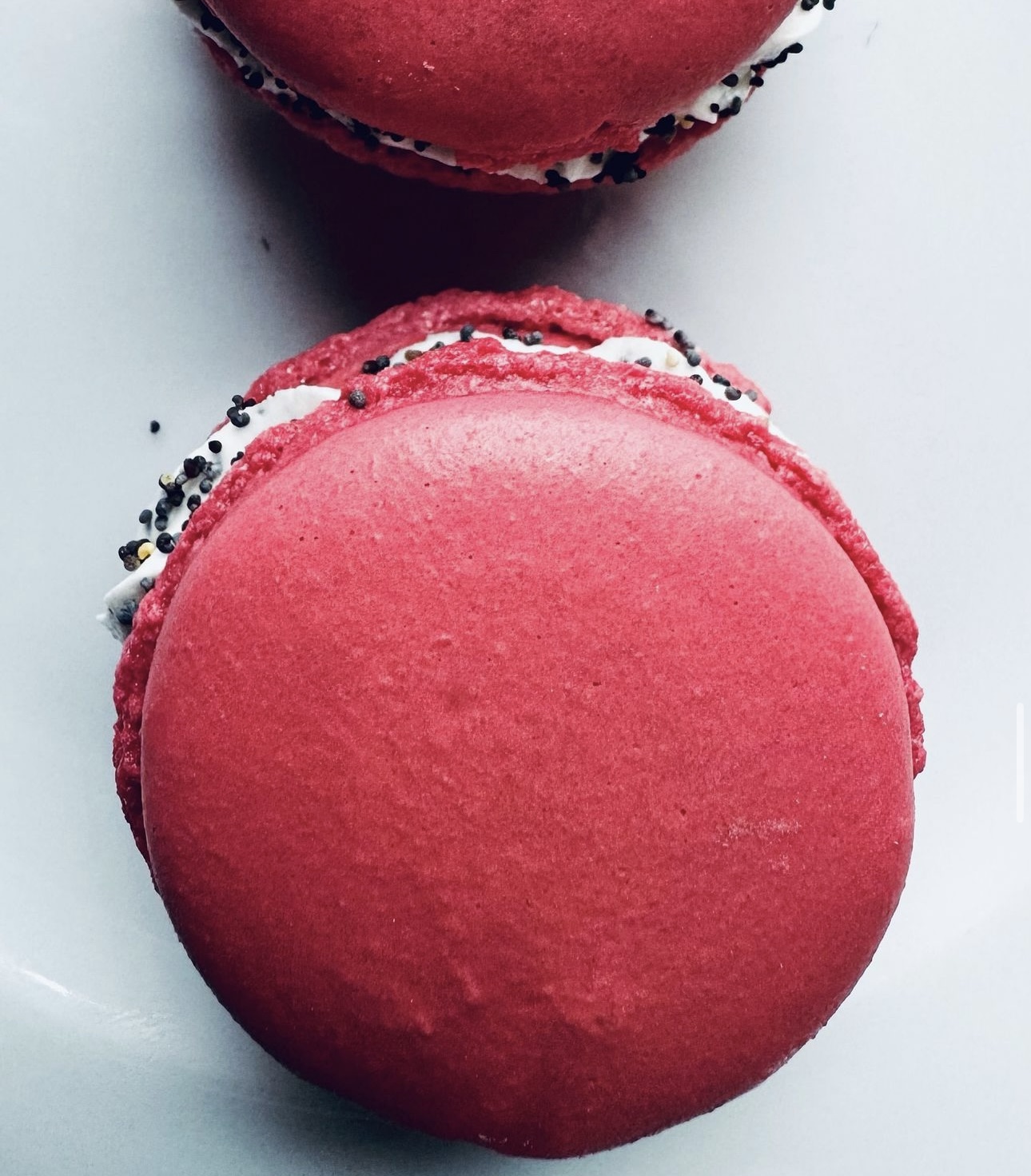
For my Macaron Pitaya-Coquelicot, the almond shell becomes the foundation for a more unusual combination of flavors.
Freeze-dried dragon fruit powder provides the fuchsia color. Dragon fruit jam forms the center, surrounded by poppy vanilla buttercream.
The decision to use freeze-dried powder rather than fresh purée in the shells is technical.
Macaron batter is sensitive to moisture. Introducing a substantial quantity of fresh fruit purée can alter the meringue and make the final consistency difficult to control.
Freeze-dried powder allows the fruit's color and some of its character to be incorporated without the same quantity of additional water.
Even then, natural color requires realistic expectations. Dragon fruit pigments can be affected by heat and the conditions of baking. A vivid batter does not guarantee an equally vivid finished shell.
The filling introduces a different set of considerations.
The dragon fruit jam needs enough concentration to remain in place without saturating the shells. The buttercream provides a protective ring around it, while vanilla and poppy seeds contribute their own aromatic and textural qualities.
I particularly like the decision to finish the exposed buttercream edge with additional poppy seeds.
The seeds interrupt the otherwise smooth construction of the macaron. Their small, dark forms provide a visual contrast against the fuchsia shells, but they also introduce a delicate texture that makes the pastry feel less uniform.
The final stage is maturation.
Once filled, the macarons rest in the refrigerator for approximately twenty-four hours. Moisture gradually moves from the filling into the shells, softening their interiors and producing the characteristic contrast between the delicate exterior and tender center.
A freshly assembled macaron and a properly matured one are not quite the same dessert.
Patience is part of the recipe.
Frangipane and the Pleasure of Richness
Where the macaron asks the almond to participate in a fragile, aerated structure, frangipane invites it to become something substantial.
The filling is traditionally associated with a mixture of almond cream and pastry cream, although in contemporary recipe usage, frangipane is also frequently used to describe almond cream made from butter, sugar, ground almonds, and eggs.
The distinction is worth knowing, even if the terminology varies between kitchens.
The preparation used in my strawberry tart is an almond cream.
Butter and sugar are beaten together before egg, almond flour, and flavoring are incorporated. During baking, the mixture expands slightly and sets into a tender filling.
Unlike a macaron shell, it is not intended to be crisp or airy.
Its appeal comes from richness and the way that richness supports other ingredients.
Almond has a gentle sweetness that becomes more pronounced when combined with butter. It is assertive enough to remain recognizable beneath fruit, yet sufficiently restrained to avoid dominating the entire pastry.
That makes frangipane particularly effective in tarts.
Pears, cherries, apricots, and berries can all benefit from the contrast between their natural acidity and the mellow richness of baked almond cream.
Strawberries offer a slightly different challenge.
Their delicate texture and high moisture content make them particularly attractive as a fresh finishing element rather than something that must endure prolonged baking.
In this tart, they are added after the frangipane has baked and cooled.
That decision preserves their shape, color, and fresh character.
The Architecture of L’Amande
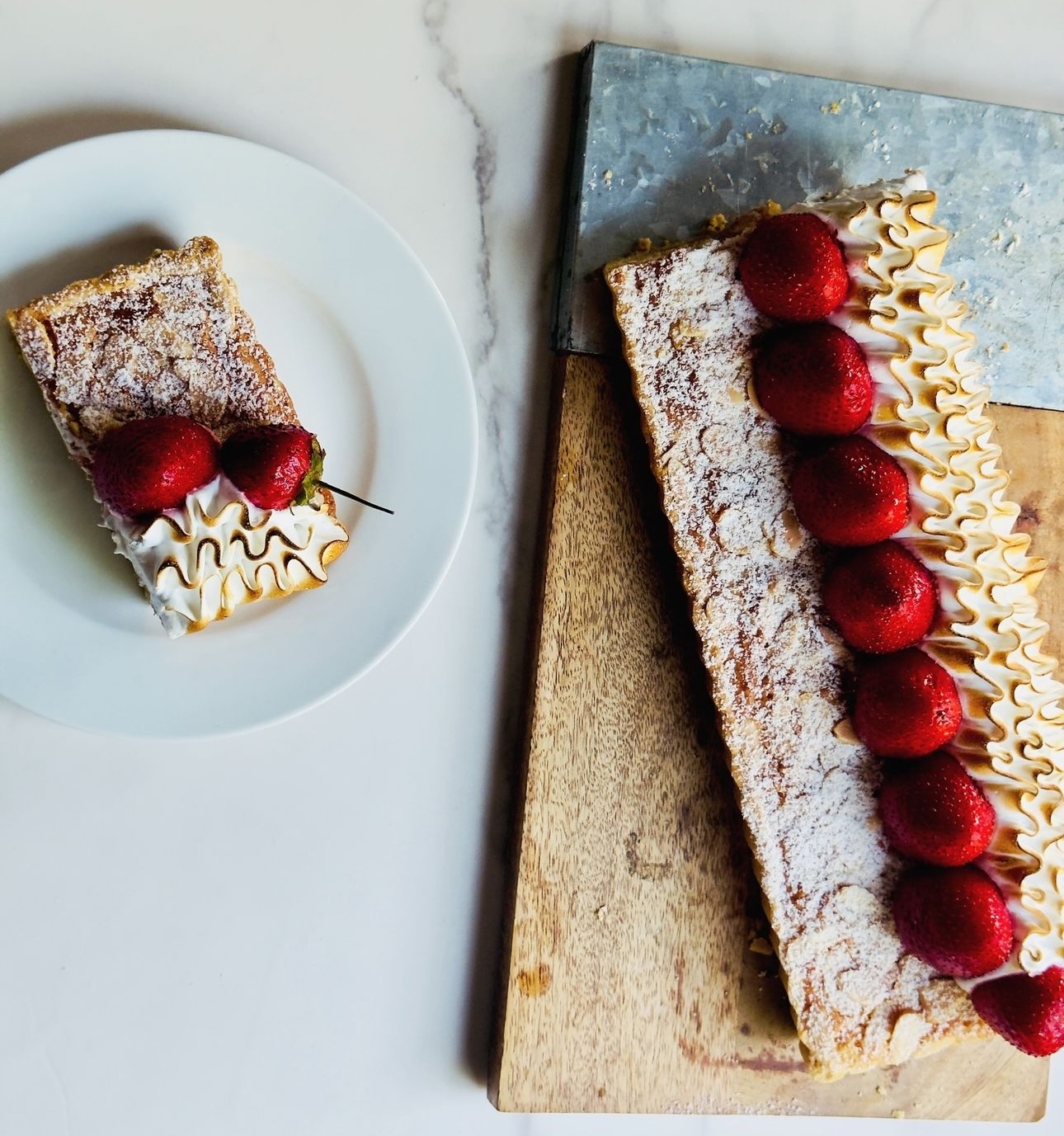
The Strawberry & Frangipane No. 01 is built in layers, each with a distinct responsibility.
The foundation is pâte sucrée, a sweet pastry dough enriched with butter, powdered sugar, egg yolk, and a small quantity of almond flour.
The almond flour contributes tenderness, but the wheat flour remains important for the shell's structure.
The dough is chilled, rolled thinly, fitted into a rectangular tart pan, and blind-baked before the filling is added.
That preliminary baking matters.
It gives the pastry a chance to develop structure before it must support the moist almond filling. Without it, the base risks remaining underbaked while the frangipane cooks.
The frangipane is then spread into the shell, scattered with flaked almonds, and baked until golden and set.
At this point, the tart could stand on its own.
But the final composition is what gives this particular preparation its identity.
A light dusting of powdered sugar creates a quiet surface. Whole strawberries, trimmed to stand upright, are glazed with apricot jam and arranged in a precise row slightly right of center.
Alongside them, French meringue is piped into a continuous border and lightly toasted.
The arrangement is intentionally asymmetrical.
The strawberries contribute height and brilliant color. The meringue provides a softer, more sculptural form, its ridges catching the flame and developing patches of golden brown.
The almond filling remains visible, rather than disappearing beneath an uninterrupted covering of fruit or cream.
I like that restraint.
Each component is allowed to retain its own character.
The result is a tart that depends on composition as much as flavor, but the composition has a practical logic. The crisp pastry supports the almond filling, the fruit supplies freshness, and the meringue introduces sweetness and a soft contrast to the baked layers beneath it.
For a French meringue that is only lightly torched, pasteurized egg whites are the appropriate choice, since browning the exterior does not reliably cook the interior.
The finished tart is best served the day it is assembled.
Its different textures are at their most distinct before the fruit and meringue begin to affect the pastry beneath them.
Two Expressions of Almond
The difference between these preparations is instructive.
In the macaron, the almond must be finely ground, evenly distributed, and incorporated into a foam whose stability is easily compromised.
In the tart, it is mixed with butter and egg to produce a filling that is intentionally rich and tender.
One preparation depends on preserving air. The other relies on creating a cohesive mixture that will set in the oven.
Both require careful measurement, but they reward different kinds of attention.
The macaron asks you to observe the behavior of a batter as it changes through folding. The frangipane asks you to understand how fat, egg, and ground almonds combine into a filling capable of holding its shape without becoming dry.
There is no universal technique for working with almond flour.
Its usefulness comes from understanding the role it plays in each preparation.
Macaron Pitaya-Coquelicot
Fuchsia macarons with dragon fruit jam and poppy vanilla buttercream.
VIEW RECIPE →Strawberry & Frangipane No. 01
Almond frangipane tart with glazed strawberries and torched French meringue.
VIEW RECIPE →The Problem with Perfection
French pâtisserie has a reputation for precision, and that reputation is largely deserved.
There are good reasons to weigh ingredients carefully, control temperatures, and repeat techniques until they become familiar.
But precision can become confused with perfection.
A macaron with an exceptionally smooth shell is not necessarily delicious. A tart arranged with mathematical accuracy is not automatically balanced.
Appearance tells us something about technique. It does not tell us everything about flavor.
The most satisfying pastries demonstrate both.
A macaron should offer more than a flawless exterior. Its filling should have a recognizable character, and the shell should contribute texture without becoming an obstacle to eating it.
A frangipane tart should taste distinctly of almond. Its pastry should remain crisp enough to support the filling, and the fruit should contribute something more meaningful than decoration.
Those are the standards that matter to me.
The visual discipline of pastry is valuable because it can reflect care, consistency, and intention.
It becomes less interesting when appearance is treated as the final objective.
The Almond Beneath It All
Almond is not a particularly dramatic ingredient.
It does not announce itself through an unusual color or an aggressive aroma. Its flavor is familiar enough that it can be overlooked, especially when paired with fruit, chocolate, or more conspicuous ingredients.
Yet its influence on pastry is profound.
Ground finely, it can contribute to a shell so delicate that its success depends on the smallest adjustments in technique.
Combined with butter and eggs, it becomes a rich filling that holds its own beneath fresh strawberries and toasted meringue.
The same ingredient supports two entirely different ideas of what dessert can be.
I like the contrast between a fuchsia macaron, its shell giving way to poppy vanilla buttercream and dragon fruit jam, and a slice of strawberry frangipane tart, where crisp pastry meets tender almond cream and fresh fruit.
One is small, enclosed, and meant to be eaten in a few bites.
The other is architectural, its components arranged openly and deliberately.
Both reveal something about the almond that would be easy to miss if we considered it only for its flavor.
It is an ingredient capable of creating structure without demanding attention.
And perhaps that is the most compelling quality of all.
The almond rarely needs to be the loudest thing on the plate.
It simply needs to be understood.