THE PASS / CULINARY SCIENCE
Envelopes
On the architecture of pastry, the forces that make dough rise, and the structures we create to hold something delicious.
An essay by Andre Ford
A pastry is not finished when it comes out of the oven.
Sometimes its most important transformation happens afterward: when the heat recedes, when an inflated structure settles, when a knife opens a seam, or when something entirely different is introduced into the space the baker has created.
Consider two pastries that appear to have very little in common.
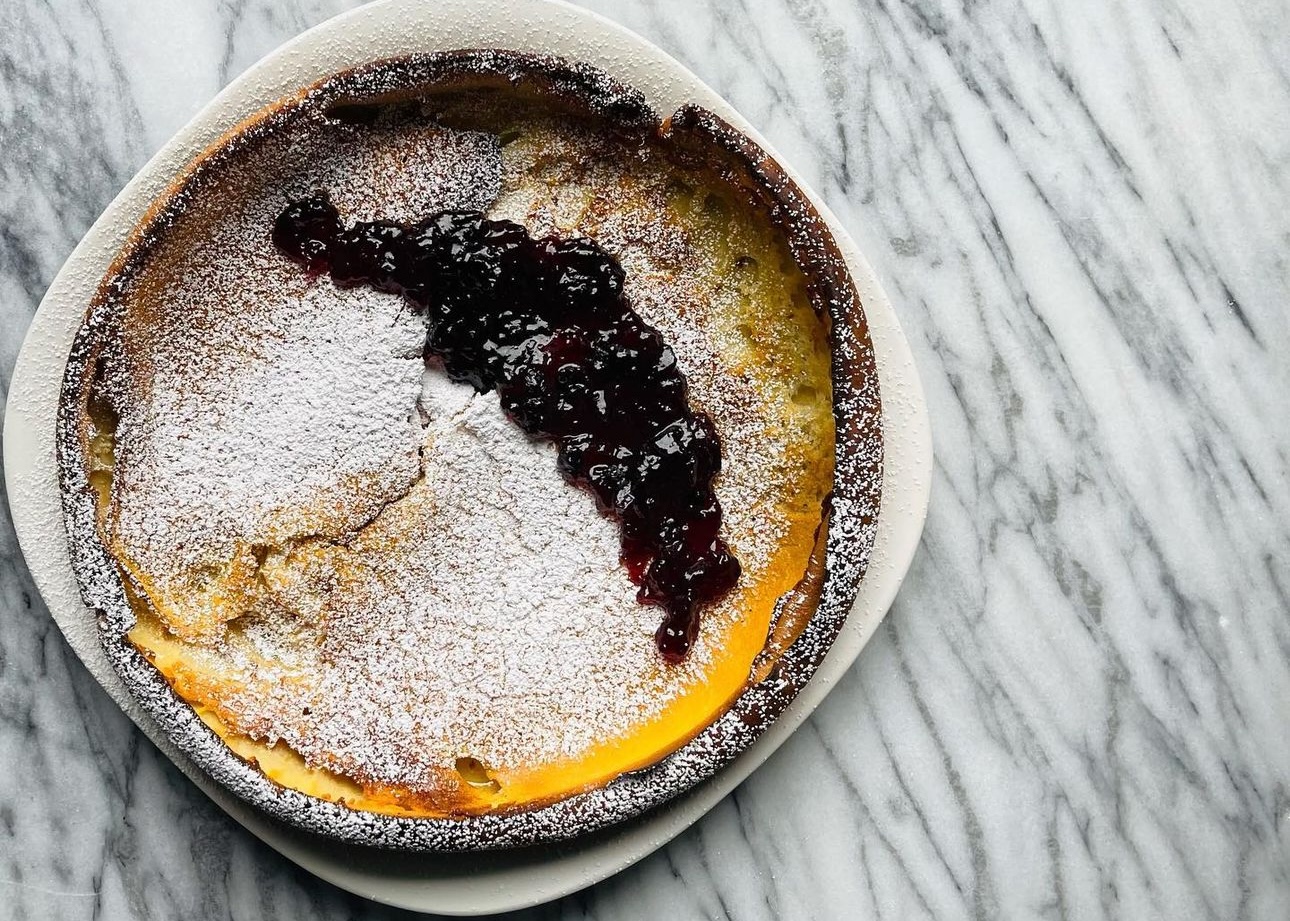
The Dutch baby arrives at the table with considerable theatricality. Its edges have climbed the walls of a hot skillet, forming an irregular golden perimeter around a softer center. Powdered sugar catches on its ridges. Fruit settles into the shallow depression that appears almost as soon as the pan leaves the oven. Its architecture is temporary, and that impermanence is part of the pleasure.
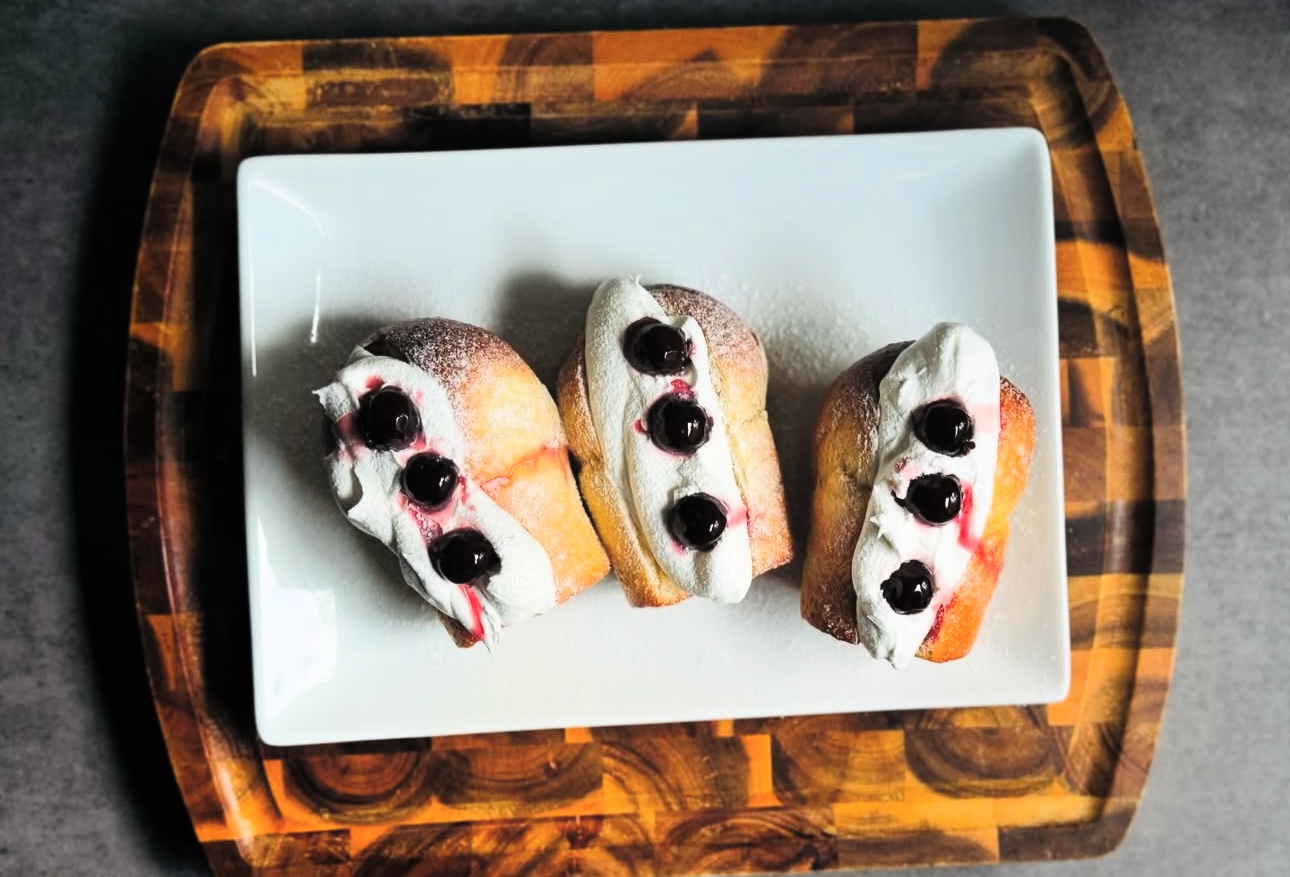
The maritozzo is more restrained. A small, golden, oval bun is baked, cooled, and opened along its length. Whipped cream fills the incision, often so generously that the bread appears to exist primarily to contain it. In my version, Amarena cherries sit along the cream's center, their dark, concentrated sweetness interrupting the richness beneath.
One pastry expands dramatically and then contracts. The other grows slowly and is deliberately opened.
Both are exercises in making room.
The Shape of Air
In pastry, air is rarely just air. It may begin as a bubble incorporated by mixing, a pocket of carbon dioxide produced by yeast, or water vapor expanding under heat. Each mechanism behaves differently, and each asks something particular of the ingredients surrounding it.
A Dutch baby is built from a comparatively simple batter: eggs, milk, flour, sugar, and seasoning. There is no baking powder and no yeast. Its rise depends principally on steam, assisted by the air incorporated during mixing.
Water expands enormously when it becomes vapor. In a sufficiently hot oven, the moisture in the batter produces steam that pushes against the developing structure around it. The eggs begin to set, starch in the flour gelatinizes, and the batter becomes capable of holding some of that expansion long enough to form the pancake's extraordinary shape.
A cast-iron pan preheated to 425°F supplies immediate, intense heat. The butter foams against the metal. When the batter is poured into the skillet, the temperature difference initiates rapid cooking at the surface in contact with the pan. The oven then supplies the sustained heat needed for expansion and setting.
The result is not simply a pancake made larger by a hot oven. It is a structure shaped by the relationship between heat transfer, moisture, and the rate at which proteins and starches become firm enough to resist collapse.
As the Dutch baby leaves the oven, steam condenses and internal pressure falls. The inflated edges begin to settle. What seemed, moments earlier, like a towering structure becomes something closer to a shallow bowl.
This is not a failure of technique. It is the expected behavior of the pastry. The collapse creates the form in which it is best served.
The Patience of Fermentation
The maritozzo approaches expansion from the opposite direction. Its structure begins long before it enters the oven.
Yeast consumes available sugars and produces carbon dioxide during fermentation. The gas collects within the dough's developing network of gluten, gradually enlarging pockets that will become part of the finished crumb. But fermentation alone does not produce a good maritozzo. The dough must be capable of retaining the gas.
Bread flour supplies proteins that, when hydrated and worked, form gluten. Kneading organizes this network into something elastic enough to stretch without immediately tearing. Eggs contribute water, proteins, fat, and richness. Butter tenderizes the crumb while changing how the dough stretches and handles.
Adding softened butter gradually, after the dough has begun to come together, allows the gluten structure to develop before a substantial amount of fat is incorporated. The dough becomes smooth and elastic rather than merely soft.
The first rise allows fermentation to enlarge the dough. Shaping redistributes the gas and establishes the form. The second rise gives each oval bun time to become light again before baking.
In the oven, the gases already present expand, yeast remains active briefly as the dough warms, and steam contributes additional lift. Eventually, heat sets the crumb and fixes the shape.
Where the Dutch baby depends on an abrupt transformation, the maritozzo depends on a sequence of smaller ones. One is an event. The other is a process. Yet neither is complete merely because it has risen.
The Space Between
The most interesting feature of these pastries is not the air they contain, but what happens when that air has done its work.
The Dutch baby is served while still hot, when the crisp edges contrast with the tender center. Its irregular depression receives powdered sugar and fruit. A spoonful of mixed berry compote brings moisture, acidity, and concentrated sweetness to a pastry whose batter is only lightly sweetened.
A crisp edge eaten alone is different from a piece dragged through the fruit. The tender center, which absorbs more of the compote, offers another texture altogether. The pastry has not been constructed as a sealed container, but its final shape gives the fruit somewhere to settle.
The maritozzo creates a more deliberate cavity. Once cooled, the bun is sliced lengthwise without cutting through its base. The two sides open, and the interior becomes a space for whipped cream. Its crumb needs to be tender enough to eat easily but resilient enough to survive cutting, handling, and filling.
The cream is not an incidental garnish. It determines the proportions of the finished pastry. In a traditional Roman maritozzo, the contrast between the soft, lightly sweetened bun and the abundant whipped cream is central to its identity.
My version adds Amarena cherries. These small, dark sour cherries, preserved in syrup, bring a different register of sweetness. Their concentrated fruit flavor and acidity provide contrast to the cream, while their glossy appearance makes a sharp visual interruption in an otherwise pale filling.
They also make the pastry more complicated to eat, which is not necessarily a disadvantage. A maritozzo should not require the manners of a formal dining room. Its pleasure lies partly in the fact that bread and cream resist being made entirely tidy.
A Matter of Origins
The two pastries also carry different culinary histories.
The Dutch baby belongs to an American tradition associated with German-style oven pancakes. Its name is generally connected to the German-American cooking tradition rather than to the Netherlands, despite the suggestion of the word Dutch. The familiar account of its naming points to the Manca family and their Seattle restaurant in the early twentieth century, although the broader family of baked, egg-rich pancakes predates that particular name.
Its modern appeal is easy to understand. Few breakfast preparations deliver such a dramatic result from so few ingredients. It is also unusually responsive to presentation. A Dutch baby can move toward sweet or savory service, elaborate toppings or very little beyond sugar and lemon.
The maritozzo comes from a different social and culinary tradition. Closely associated with Rome, it has a history that reaches beyond the contemporary cream-filled pastry displayed in bakery windows. Earlier forms were simpler sweetened breads, sometimes enriched with dried fruit, and maritozzi became associated with courtship and seasonal customs. The familiar whipped-cream-filled version is a later expression of that tradition.
Today, the visual identity of the maritozzo is unmistakable: a soft oval bun, opened generously, with a striking quantity of cream visible between its sides.
The two pastries therefore arrive at similar ideas through different histories. The Dutch baby turns a humble batter into an immediate spectacle. The maritozzo transforms enriched bread into a pastry through its filling. Neither requires the other to explain itself. But placed together, they reveal how much of baking depends on the purposeful creation of empty space.
What a Pastry Can Hold
Bakers spend considerable time thinking about what ingredients do when combined. Flour provides structure. Eggs bind and set. Fat changes tenderness and flavor. Sugar sweetens, encourages browning, and influences moisture. Yeast ferments. Heat transforms.
These explanations are useful, but they can make pastry sound like a collection of independent chemical functions. It is more interesting to consider what those functions accomplish together.
A batter must remain fluid long enough to expand, then set before its shape disappears entirely. A yeast dough must be extensible enough to accommodate fermentation, then strong enough to retain its form. A bun must be baked before it can be split, and cooled before it can accept whipped cream without melting the filling.
The timing is as important as the ingredients. There is also an important difference between containment and absorption.
The Dutch baby's tender center can take up some of the moisture from its fruit topping, while its crisp perimeter provides contrast. The maritozzo's open seam primarily holds its cream and cherries between two sides of bread. It is not designed to be saturated with syrup like a rum baba.
These are distinct structural solutions to a related culinary question: how does a pastry accommodate something added after baking?
The answer is written into its architecture. A dense crumb, a fragile shell, a laminated sheet, a hollow choux puff, a set custard, and a fermented bun each offer different possibilities. Some can be filled. Some can be soaked. Some can support a topping. Others must be eaten before moisture destroys the quality that makes them appealing.
Technique determines which possibilities remain available.
The Finished Form
There is a temptation to regard the moment of maximum rise as the achievement. The Dutch baby at its highest. The dough at the end of its proof. The bun as it emerges from the oven, golden and intact.
But height is not the same as completion.
A Dutch baby is most compelling after its dramatic expansion has yielded to a shape that can receive fruit. A maritozzo becomes recognizable only after the knife has interrupted the finished bread and cream has occupied the opening.
In each case, the pastry must undergo one final change. The Dutch baby gives up some of its volume. The maritozzo gives up the integrity of its crust.
What remains is not diminished. It has become useful in a different way.
Perhaps that is the quieter lesson of these two preparations. Good pastry is not always about creating the strongest structure or preserving the greatest volume. Sometimes it is about understanding exactly how much structure is needed, what it should support, and when it should yield.
The empty space is not an accident. It is what makes room for the rest.
FROM THE KITCHEN
Two recipes
Dutch Baby →
An oven-puffed skillet pancake with mixed berry compote, powdered sugar, and optional lemon.
Maritozzo all’Amarena →
Soft Italian brioche-style buns filled with whipped cream and finished with Amarena cherries.
Original recipes and photography by Andre Ford.